
 Translate


1. The Problem: "Placeable" Substitution vs. Grammatical Agreement
In the current version of Trados Studio (see attached screenshot of Options > Editor > Auto-propagation), the software treats segments containing Placeables (numbers, dates, variables) as identical context matches.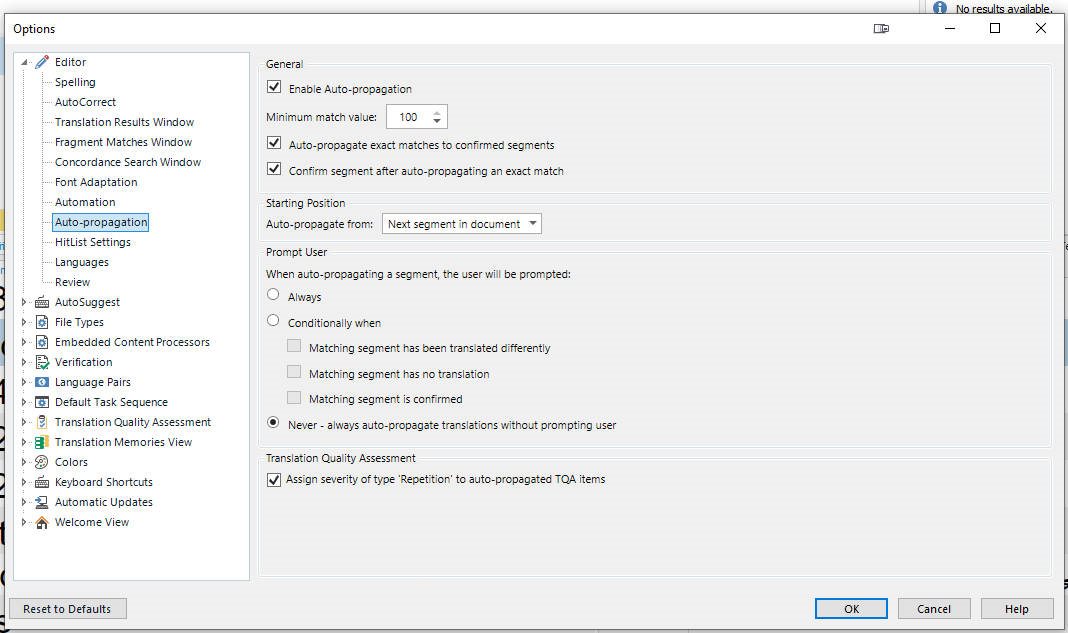
If Segment A is [7] days and Segment B is [11] days, Trados views the text "days" as a 100% match and auto-propagates the translation from A to B, simply swapping the number.
However, in Arabic, the noun following a number changes its grammatical form (singular, plural, case) based on the value of that number.
-
English: 7 days, 11 days (Invariant "days").
-
Arabic (Correct): 7 أيام (Plural), 11 يوماً (Singular Accusative).
-
The Error: If I translate "7 days" as "7 أيام" and confirm, Trados Auto-propagates to the "11 days" segment, creating "11 أيام". This is a critical grammatical error.
This forces the translator to manually disable auto-propagation or constantly perform "Undo" actions, significantly slowing down productivity and increasing the risk of QA failures.
2. Proposed Solution: The "Exclusion List"
I propose adding a configuration feature within the Auto-propagation settings (referenced in the attached screenshot) that prevents the engine from overwriting segments containing specific keywords.
UI Implementation (Reference: Screenshot)
In the General section of the Auto-propagation settings:
-
Add a button labeled "Exceptions..." or "Exclusion List".
-
This opens a dialog box where the user can input Source Language terms (words or phrases).
-
Logic:
IF (Target_Segment_Status == Unconfirmed) AND (Source_Segment CONTAINS item_from_Exclusion_List) THEN (Do_Not_AutoPropagate).
Advanced Implementation (Regex Support)
For power users, allow Regular Expressions.
-
Example:
\d+ (day|days) -
This ensures that the auto-propagation is blocked only when the word "days" is preceded by a number, which is the trigger for the grammatical change.
3. Linguistic Data: The Arabic Exclusion List
To demonstrate the necessity of this feature, below is a list of common terms where Arabic grammatical rules (Number-Noun Agreement) make standard auto-propagation dangerous.
The Developers must understand that in Arabic:
-
3 to 10: Takes Plural Genitive.
-
11 to 99: Takes Singular Accusative.
-
100, 1000: Takes Singular Genitive.
Because Trados treats the number as a variable placeable, it applies the translation of the first confirmed segment to all others, breaking these rules.
A. Time Units (High Priority)
These are the most common errors found in project files.
| English Source Key | Arabic Variation 1 (3-10) | Arabic Variation 2 (11-99) | Arabic Variation 3 (100/1000) |
| Day / Days | أيام (Ayyam) | يوماً (Yawman) | يومٍ (Yawm) |
| Hour / Hours | ساعات (Sa'at) | ساعةً (Sa'atan) | ساعةٍ (Sa'a) |
| Week / Weeks | أسابيع (Asabee') | أسبوعاً (Usbu'an) | أسبوعٍ (Usbu') |
| Month / Months | أشهر (Ash-hur) | شهراً (Shahran) | شهرٍ (Shahr) |
| Year / Years | سنوات (Sanawat) | سنةً (Sanatan) | سنةٍ (Sana) |
| Minute / Minutes | دقائق (Daqa'iq) | دقيقةً (Daqiqatan) | دقيقةٍ (Daqiqa) |
| Second / Seconds | ثوان (Thawan) | ثانيةً (Thaniyatan) | ثانيةٍ (Thaniya) |
B. Dimensions & Measurement
| English Source Key | Arabic Variation 1 (3-10) | Arabic Variation 2 (11-99) |
| Meter / Meters | أمتار (Amtar) | متراً (Metran) |
| Kilometer / Kilometers | كيلومترات (Kilometrat) | كيلومتراً (Kilometran) |
| Liter / Liters | لترات (Litrat) | لتراً (Litran) |
| Kilogram / Kilograms | كيلوجرامات (Kilogramat) | كيلوجراماً (Kilograman) |
| Inch / Inches | بوصات (Bosat) | بوصةً (Bosatan) |
| Page / Pages | صفحات (Safhat) | صفحةً (Safhatan) |
C. Currency
| English Source Key | Arabic Variation 1 (3-10) | Arabic Variation 2 (11-99) |
| Dollar / Dollars | دولارات (Dolarat) | دولاراً (Dolaran) |
| Euro / Euros | يورو (Euro) | يورو (Euro) - Exception: often remains static, but grammar purists may vary. |
| Pound / Pounds | جنيهات (Gunayhat) | جنيهاً (Gunayhan) |
| Riyal / Riyals | ريالات (Riyalat) | ريالاً (Riyalan) |
D. General & Medical Contexts
| English Source Key | Arabic Variation 1 (3-10) | Arabic Variation 2 (11-99) |
| Patient / Patients | مرضى (Marda) | مريضاً (Mareedan) |
| Dose / Doses | جرعات (Gura'at) | جرعةً (Gura'atan) |
| Tablet / Tablets | أقراص (Aqras) | قرصاً (Qursan) |
| Visit / Visits | زيارات (Ziyarat) | زيارةً (Ziyaratan) |
| File / Files | ملفات (Malaffat) | ملفاً (Malaffan) |
| Error / Errors | أخطاء (Akhta') | خطأً (Khata'an) |
4. Summary of Impact
Implementing an Exclusion List based on the source text allows the translator to "Block" these specific words from the Auto-propagation engine.
-
Current State: Translator confirms "5 days" > Trados overwrites "15 days" with incorrect grammar > Translator must spot error and fix.
-
Desired State: Translator adds "days" to Exclusion List > Trados sees "days" in the source > Trados skips Auto-propagation > Translator enters correct grammar for "15 days" manually.
This is a vital Quality of Life (QoL) update for all translators working into Arabic, Hebrew, Russian, Polish, and other languages with complex pluralization rules.
I hope this really gets implemented soon as it is very frustrating and sometimes leads to very embarrassing QA issues.
Thanks a lot and please keep the good development work.
Sincerely,
Sameh Ragab
ISO 17100 Lead Auditor and Certified Translation Provider
UN and Worldbank Registered Translation Consultant
