
The Trados cloud platform will be undergoing maintenance on Saturday, 9th May 2026 between 05:00 to 17:00 UTC. During this time, you will not be able to log in to the Trados platform.

Where else do plug-ins live?

Ever since upgrading to 2017 in November, I could not get the beta 0.9.1.0 of the LanguageTool plug-in to work. Since I have not needed to fire up 2015 even once, since then, I have now removed 2015 from my system. (I know that I cannot reinstall it again.) I have verified that the 12 and 12.0.0.0.0 directories have gone from AppData/Roaming/SDL/SDL Trados Studio. The LanguageTool plug-in still did not work. So, I removed the plug-in also from 14/Packages and 14/Unpacked, with the intention of reinstalling the plug-in.

The weird thing is that the plug-in is still listed within Studio and I can actually access its settings. How can that be, if I have deleted it and have restarted my system? There is no reference to it in the registry either. So, where else do plug-ins live, in addition to their proper place under AppData?

I am not sure whether the plug-in is working. I am not getting any (software-related) error messages now, but I am not getting any language-related messages either, even though I have deliberately written some words with wrong spelling.

I have upgraded LanguageTool to Version 3.6 and updated the path in the Java server batch file accordingly.

Any ideas, please?


AbdulRahiem

  • Hello,

    I do not know about Studio 2017 yet, but in Studio 2015 we have plugins installed in these two folders:

    <UserProfile>\AppData\Roaming\SDL\SDL Trados Studio\12\Plugins
    <UserProfile>\AppData\Local\SDL\SDL Trados Studio\12\Plugins

    You may wish to check in both "Roaming" and "Local".
    Hope that this helps.


    With best wishes,
    Gueorgui

  • Thank you for your response, Gueorgui, but that was not my question. I actually wrote that I deleted the LanguageTool plug-in from that location (uninstalled Studio 2015 completely and deleted the plug-in from ….\SDL Trados Studio\14\Plugins), but nonetheless it still appears in Studio. Because, obviously, it cannot detect something that has been deleted, there must be some other place, where plug-ins are located. And that is what I am trying to find out.

    Thank you anyway.

    AbdulRahiem
  • Hi AbdulRahiem,

    I think Gueorgui was on the right track. He also mentioned another path, local, as opposed to roaming which you checked. Plugins can be in three different locations:

    c:\Users\[USERNAME]\AppData\Roaming\SDL\SDL Trados Studio\14\Plugins\

    c:\Users\[USERNAME]\AppData\Local\SDL\SDL Trados Studio\14\Plugins\

    c:\ProgramData\SDL\SDL Trados Studio\14\Plugins\

    Maybe check all three locations. This is for Studio 2017 clearly... look in 12 as opposed to 14 for Studio 2015.

    Regards

    Paul

    Paul Filkin | RWS

    Design your own training!
    You've done the courses and still need to go a little further, or still not clear? 
    Tell us what you need in our Community Solutions Hub

  • Hi Paul,

    Sorry, but Gueorgui did not read my message correctly. The situation was as follows:

    1) SDL Trados Studio 2015 had been TOTALLY REMOVED from my machine (I thought). Hence, no \12\ directories any more;
    2) The plug-in had been deleted from both the Packages and Unpacked directories under \14\;
    3) With the plug-in deleted from every (to me) known place, it still appeared in Studio 2017 and the settings could be accessed.

    So, to recap, my question was: if the plug-in does not exist under /12/, nor under /14/, where else could it be? How could Studio 2017 list a plug-in that is not supposed to exist?

    But now you have provided the answer, even though it raises another point.

    There were still entries under ProgramData. Even though I uninstalled Studio 2015, lo and behold, the /12/ directories were still there, with contents. Also, the plug-in was there under the /14/ directories. Now that I have deleted it from there, it has indeed gone and I can reinstall it from scratch.

    Still, before I posted my question, I checked SDL product help. (SDL Translation Studio - Integration API - Plug-in deployment). It does indeed warn that it is preliminary documentation and is subject to change. However, under 'Uninstalling a Plug-in Package', reference is only made to the directories under AppData. Nowhere is it mentioned that there are also entries under ProgramData.

    So, the answer to my question "Where else do plug-ins live?" is a simple one: Under ProgramData.

    Thank you for always patiently helping everyone.

    Best regards,

    AbdulRahiem
  • Hello AbdulRahiem,

    ok - glad your problem is resolved.  But I, clearly incorrectly,  read the same as Gueorgui as you only mentioned this folder:

    AppData/Roaming/SDL/SDL Trados Studio

    I think the point was he was trying to show you was they are also in the local folder and not just roaming, so I just added the third location.  I wouldn't get hung up on versions as the intent was correct and he only has 2015 installed so could not be 100% of Studio 2017 locations.

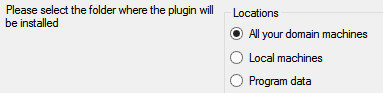
    Maybe also note for interest the plugin installer which has options for all three locations:

    And an explanation of these in case anyone was wondering:

    All your domain machines (Roaming) : this contains data that can move from one machine to another if you log on with your user profile

    Local machines : this contains data that will not move with your user profile, so specific to the machine you installed on

    Program data : this contains data that is not specific to a single user profile at all

    Glad you're all resolved now anyway and apologies for misunderstanding you.

    Regards

    Paul

    Paul Filkin | RWS

    Design your own training!
    You've done the courses and still need to go a little further, or still not clear? 
    Tell us what you need in our Community Solutions Hub

  • Thank you for your involvement, Paul. You read my intent perfectly well. Now we know that there is a third possible location for plugins (I guess this applies also to Studio 2015) and AbdulRahiem's problem is solved too.

    Great to have you around here!
    Have a nice day.
  • Yes, this applies to all versions of Studio.

    Cheers

    Paul

    Paul Filkin | RWS

    Design your own training!
    You've done the courses and still need to go a little further, or still not clear? 
    Tell us what you need in our Community Solutions Hub

  • Hi  

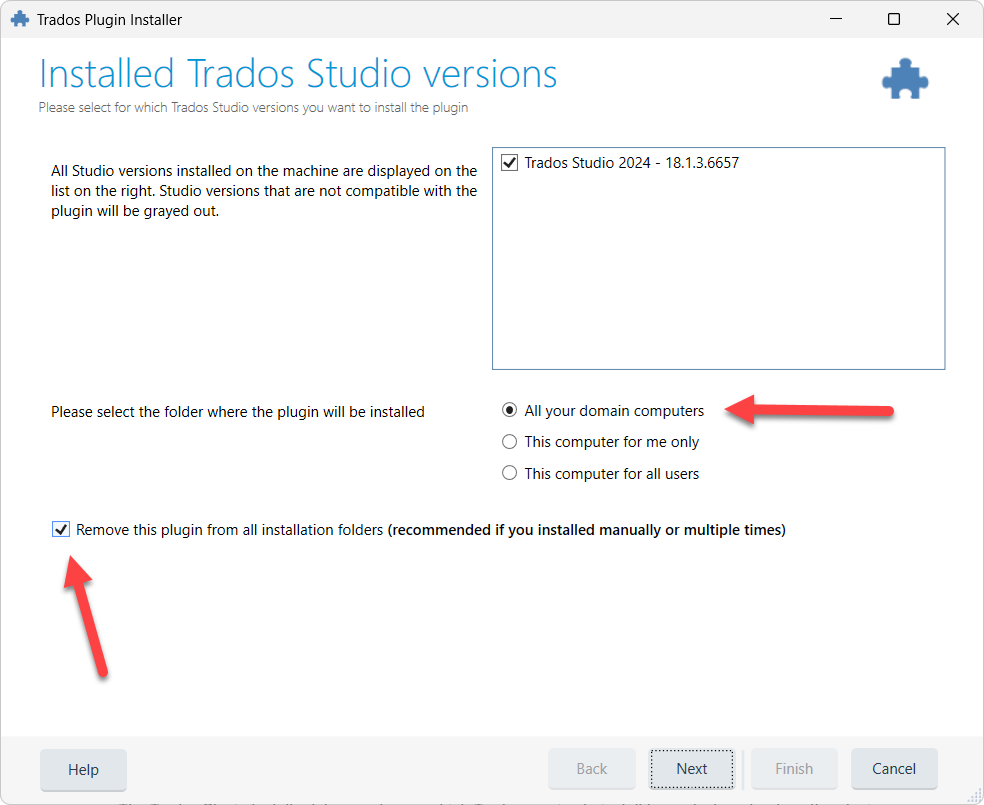
    I have a related question. I'm working on the help documentation for my Supervertaler for Trados plugin. Of the three locations that appear in the plugin installer dialogue, which would you recommend I direct new users to select, if any? My inclination was to go with the first one because the dialogue always seems to open with that one preselected, but I'm not sure.

    (1) "All your domain computers":

    Location: C:\Users\mbeijer\AppData\Roaming\Trados\
    For example: C:\Users\mbeijer\AppData\Roaming\Trados\Trados Studio\18\Plugins

    (2) "This computer for me only":

    Location: C:\Users\mbeijer\AppData\Local\Trados\
    For example: C:\Users\mbeijer\AppData\Local\Trados\Trados Studio\18\Plugins

    (3) "This computer for all users":

    Location: C:\ProgramData\Trados\
    For example: C:\ProgramData\Trados\Trados Studio\18\Plugins\Packages

    I also noticed a new option that helps with the previously messy situation where a plugin might be left in the wrong place.

    "Remove this plugin from all installation folders (recommended if you installed manually or multiple times)"


    Trados Plugin Installer window showing options for Trados Studio versions and plugin installation locations. 'All your domain computers' and 'Remove this plugin' are highlighted with red arrows.

    Here is what I have so far in my help system:

    https://supervertaler.gitbook.io/trados/getting-started/installation

    Does this sound reasonable?

    emoji


    Generated Image Alt-Text
    [edited by: RWS Community AI at 10:04 AM (GMT 1) on 24 Apr 2026]
  •   

    There are a few things worth noting however... for completeness:

    1. Path inconsistency. The Roaming path is shown as ...\Plugins\ while the other two end in ...\Plugins\Packages\. Studio stores the packaged .sdlplugin in Plugins\Packages\ and extracts to Plugins\Unpacked\ regardless of scope, so the Roaming line should also end in \Packages\.  Might be a typo.
    2. "Active Directory" framing might be a bit dated.  Roaming profile sync via classic on-prem AD is increasingly rare.  I think many corporate setups today run Entra ID (Azure AD) with Intune, FSLogix profile containers, or OneDrive Known Folder Move, and OneDrive KFM does not redirect AppData\Roaming by default.  Might be worth saying something like "in environments that sync the Roaming profile (classic AD roaming profiles, FSLogix, etc.)" rather than implying AD domains always sync it.
    3. Minor wording. "If you are not on a corporate domain network, this behaves the same as 'This computer for me only'" isn't quite right either, because it still writes to Roaming vs Local.  Functionally identical for a single-PC user, yes, but the folder is different, and this matters if they ever later join a domain or move the profile.

    Looks really comprehensive though, and more than reasonable... I like all this documentation and wish all developers did it!

    Paul Filkin | RWS

    Design your own training!
    You've done the courses and still need to go a little further, or still not clear? 
    Tell us what you need in our Community Solutions Hub

    emoji
  • Thanks for the great info, Paul, I've updated it already! Ahem, I mean Claude Code updated it.

    emoji