
DeepL API for Trados Studio providing different output than DeepL online

Our company has a DeepL Pro subscription. We noticed a discrepancy between the translations provided by the free, online version of DeepL, and the ones provided by the DeepL API for Trados Studio 2021.

We assumed the API provided the same translations as the online version, but after running many tests in various language combinations, it’s safe to say that this is not the case.

The online version is always noticeably better than the one provided by the API, but obviously we’d rather use the API directly in the CAT tool.

Could you please let us know if this can be fixed in some way?

emoji
Parents Reply
  •   

    So the answer is it’s always worse for you. In this case there is nothing we can do. It will need to be addressed by DeepL.

    we are always willing to help, but since we don’t know enough to be able to explain why it’s wrong, or what parts are specifically always wrong, or all languages or some languages, you will need to take this up with Deepl.

    We use the API they provide to build the plugin and given we don’t see this sort of complaint all over the forums, which I think we would do of it was more general and affected everyone, we can’t do anything else.

    Maybe someone else finds this a problem and can elaborate more?  

    Paul Filkin | RWS Group

    ________________________
    Design your own training!

    You've done the courses and still need to go a little further, or still not clear? 
    Tell us what you need in our Community Solutions Hub

    emoji
Children
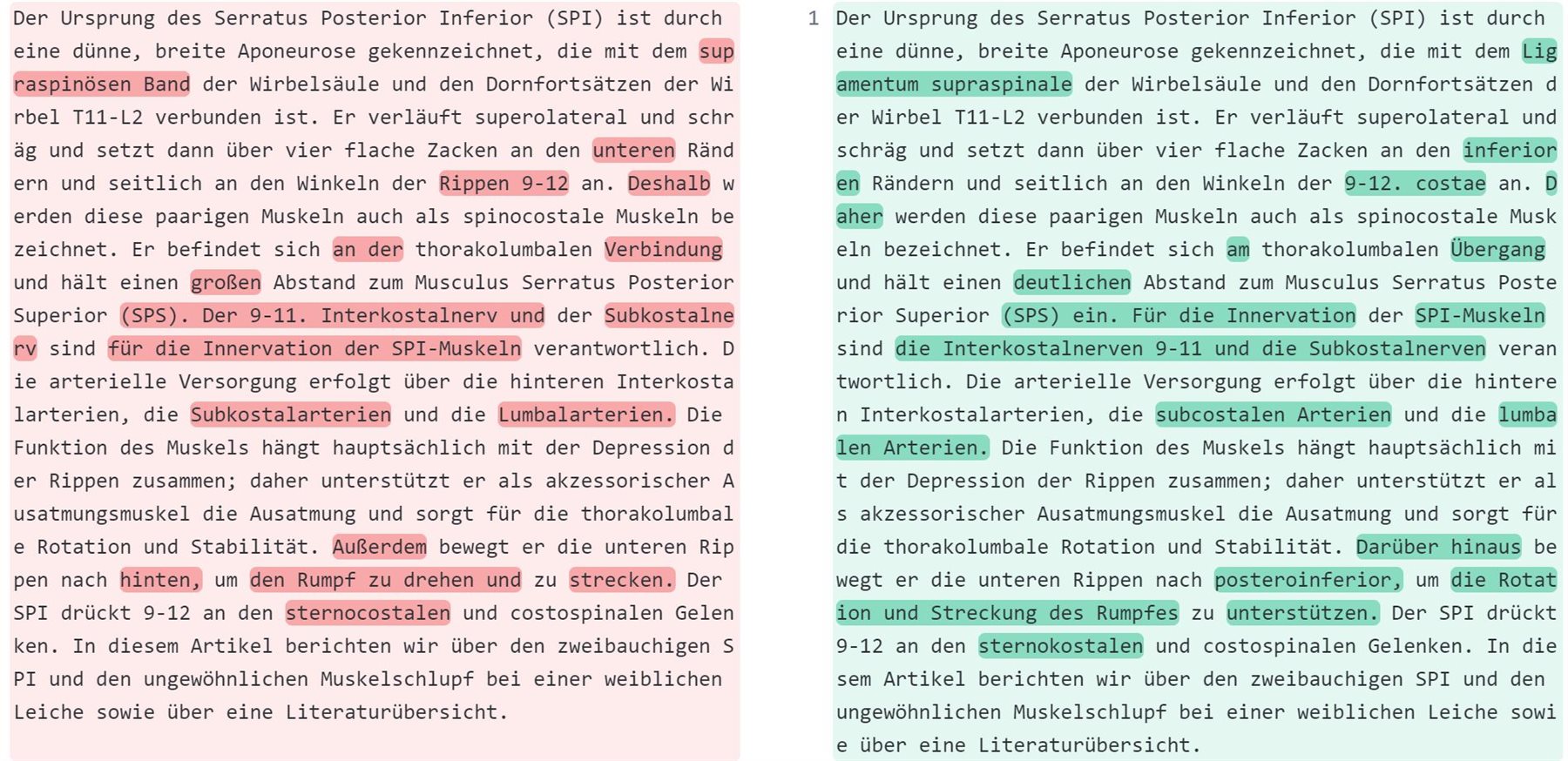
  • In this screen you can see on the left side the API output and on the right side the online output (translation from English to German). The online output is clearly better quality. This is very annoying for translators because it cost aroundish €30/monthly to use the API (i do not use it anymore because of this issue)!

    emoji
  •  

    Can you share the source text for this example?  Just a few sentences will do.

    What settings did you use in the app?

    Are you using glossaries?

    If we know exactly what you are doing and that this is a like for like comparison then we can take this to Deepl which might help your case.

    Paul Filkin | RWS Group

    ________________________
    Design your own training!

    You've done the courses and still need to go a little further, or still not clear? 
    Tell us what you need in our Community Solutions Hub

    emoji
  • Paul, below you can find the source text. No glossaries, no TM, just a simple comparisson between API and Deepl online output:

    The origin of Serratus Posterior Inferior (SPI) characterized by a thin, wide aponeurosis that's connected to the supraspinous ligament of the spine and the spinous processes of T11–L2 vertebrae. It passes superolateral and obliquely, then inserts into the inferior margins and lateral to the angles of the 9-12th costae via four flat digits. Therefore, these paired muscles are referred to as the spinocostal muscles. It is situated at the thoracolumbar junction and maintains a significant distance from the Serratus Posterior Superior (SPS) muscle. The 9-11th intercostal nerves and subcostal nerves responsible for the innervation of SPI muscles. The arterial supply is from the posterior intercostal arteries, subcostal arteries, and lumbal arteries. The function of the muscle is mainly related to the depression of the costae; therefore, it assists in expiration as an accessory muscle of expiration, and it provides thoracolumbar rotation and stability. In addition, it moves the lower ribs posteroinferiorly to help rotate and extend the trunk. The SPI depresses 9-12 at the sternocostal and costospinal joints. Herein, we report the two-bellied SPI and unusual muscular slip in a female cadaver and a literature review.

    emoji
  • As a matter of fact no TM and no Glossary was used, just a simple comparison of the following source text between API output and Deepl online output:

    The origin of Serratus Posterior Inferior (SPI) characterized by a thin, wide aponeurosis that's connected to the supraspinous ligament of the spine and the spinous processes of T11–L2 vertebrae. It passes superolateral and obliquely, then inserts into the inferior margins and lateral to the angles of the 9-12th costae via four flat digits. Therefore, these paired muscles are referred to as the spinocostal muscles. It is situated at the thoracolumbar junction and maintains a significant distance from the Serratus Posterior Superior (SPS) muscle. The 9-11th intercostal nerves and subcostal nerves responsible for the innervation of SPI muscles. The arterial supply is from the posterior intercostal arteries, subcostal arteries, and lumbal arteries. The function of the muscle is mainly related to the depression of the costae; therefore, it assists in expiration as an accessory muscle of expiration, and it provides thoracolumbar rotation and stability. In addition, it moves the lower ribs posteroinferiorly to help rotate and extend the trunk. The SPI depresses 9-12 at the sternocostal and costospinal joints. Herein, we report the two-bellied SPI and unusual muscular slip in a female cadaver and a literature review.

    emoji
  •  

    Thank you... definitely not a simple case of all translations being different.  But this is a good example we can take to DeepL for discussion as it is interesting to see this difference.  We will be asked questions though that I tested here.

    For example... if I use the basic free web DeepL I get this :

    Der Ursprung des Serratus Posterior Inferior (SPI) ist durch eine dünne, breite Aponeurose gekennzeichnet, die mit dem supraspinösen Band der Wirbelsäule und den Dornfortsätzen der Wirbel T11-L2 verbunden ist. 

    If I use the plugin I get this:

    Der Ursprung des Serratus Posterior Inferior (SPI) ist durch eine dünne, breite Aponeurose gekennzeichnet, die mit dem supraspinösen Band der Wirbelsäule und den Dornfortsätzen der Wirbel T11-L2 verbunden ist.

    Same as your poor results so it seems as if the API is not using the Pro API at all.

    We cannot test this using the web as we just get an API key from Deepl since we developed the plugin.  We don't have our own account.  But this at least gives us something to go on and we can investigate this with them to find out where the problem lies.

    I can only think the specialised nature of your texts is why you found this because we would surely have seen more complaints by now otherwise.

    Paul Filkin | RWS Group

    ________________________
    Design your own training!

    You've done the courses and still need to go a little further, or still not clear? 
    Tell us what you need in our Community Solutions Hub

    emoji
  • Thank you for investigating this. This is not unique I get this issue all the time. But you are right strange that there are no complaints…

    emoji