

The Trados cloud platform will be undergoing maintenance on Saturday, 9th May 2026 between 05:00 to 17:00 UTC. During this time, you will not be able to log in to the Trados platform.

Issue When Converting XML1 to XML2 File Types in Trados Studio (Preparing for Upgrade to 2024)

We’re currently preparing to upgrade from Trados Studio 2022 to 2024 and need to convert our existing XML1 file types to the new XML2 format. However, during this process we’re encountering a few issues related to how content is displayed in the editor.

What we're seeing:

  • In the XML1 setup, certain segments (e.g., modules marked with translate="no" from the CMS “Cosima”) were still visible in the “All Content” view – although they were locked for translation.
  • In XML2, these protected segments are no longer visible in the “All Content” view at all.
  • Additionally, some tag pairs that should be treated as inline tags are now interpreted as structure tags. This leads to the loss of spaces between words, which is especially noticeable when using Track Changes.
  • We’ve already managed to adjust single tags to behave as inline, but for tag pairs, the rule settings don’t seem to have the intended effect – especially when it comes to preserving spacing.

Questions for the community:

  • Is there a specific setting in the XML2 file type editor that forces certain tag pairs to behave as inline – similar to what we could do in XML1?
  • Has anyone encountered issues with translate="no" content in XML2 file types – particularly regarding its visibility in the Studio editor? Especially the handling of tag pairs as inline tags, as already mentioned in section 1?
  • How can we ensure that the original formatting (spaces, inline tags, etc.) is preserved when migrating from XML1 to XML2?

Example templates:

In the 'All Content' view, locked segments were still visible in XML1:
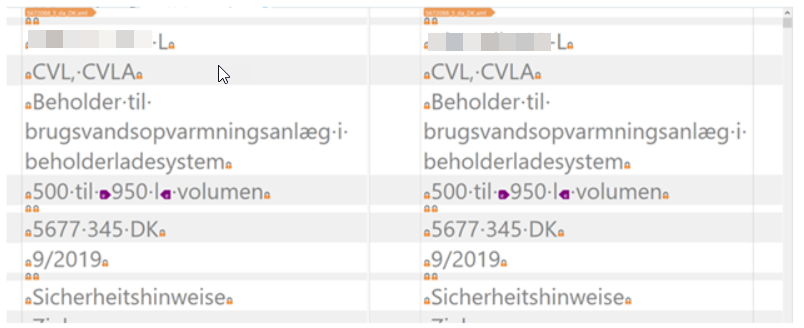
Side-by-side comparison of text segments in a translation software interface, showing differences in spacing and tag handling between two versions.

In XML2, these segments are no longer displayed – not even in the 'All Content' view:
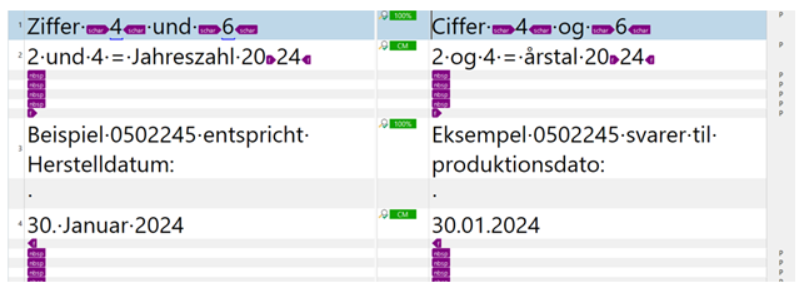
 Comparison of date formats and tag interpretations in a translation software, highlighting inconsistencies in version upgrades.

We’d really appreciate any tips, ideas, or shared experiences – thanks in advance!


Generated Image Alt-Text
[edited by: RWS Community AI at 10:04 AM (GMT 1) on 8 Apr 2025]

emoji
  • "Probability score": 0.7

    "Question improvement suggestion": To improve your question, it would be helpful to include the exact version of Trados Studio 2022 you are currently using, as well as any recent changes you've made to your system. Additionally, providing more specific examples of the issues you're encountering, such as the exact tag pairs that are causing problems, would be beneficial.

    In the meantime, based on the information you have provided, here is a suggested answer to your question:

    Hello,

    It seems like you're encountering some issues when converting XML1 file types to XML2 in preparation for your upgrade to Trados Studio 2024. Here are some suggestions that might help:

    1. Forcing certain tag pairs to behave as inline: In the XML2 file type settings, you can define how tag pairs should be treated. This is done in the "Tag Settings" section. You can specify whether a tag pair should be treated as inline or structural. If you're having trouble with specific tag pairs, please provide more details so we can give more targeted advice.

    2. Visibility of translate="no" content: In the XML2 file type, content marked with translate="no" should still be visible in the "All Content" view, but it will be locked for translation. If this is not the case, it might be a bug and you should report it to the Trados Studio team.

    3. Preserving original formatting: When migrating from XML1 to XML2, the original formatting should be preserved as much as possible. However, there might be some differences due to the new way XML2 handles certain elements. If you're noticing significant changes in formatting, it might be worth reviewing your XML2 settings and making adjustments as necessary.

    Remember, when you're setting up your XML2 file type, you can import your XML1 settings to ensure as much consistency as possible. This should help minimize any issues with formatting and tag handling.

    I hope this answer addressed your question. If not, please reject the answer, add the question improvement suggestion information, and click the RWS Community AI checkbox on the right to try again.

    RWS Community AI

    emoji
  •  

    Question for you... can you provide a sample XML file and also your XML1 settings file?

    The sample XML should be small and just represent the problem elements so anyone willing to help doesn't have to scour the XML trying to understand what you know very well.

    Paul Filkin | RWS

    Design your own training!
    You've done the courses and still need to go a little further, or still not clear? 
    Tell us what you need in our Community Solutions Hub

    emoji


  • Generated Image Alt-Text
    [edited by: RWS Community AI at 8:32 AM (GMT 1) on 9 Apr 2025]
  • Thanks for your request, Paul. I've attached the relevant sample files.

    emoji
  • Thanks  

    I can reproduce your results with the All Content no longer being shown, but have no explanation other than it looks like something of an improvement to hide all that content that surely doesn't need to be there anyway?  If you really want it create a preview.  Surely that would be better?

    On the inline tags... I did ask you to provide a small sample not an 800+ line XML.  Can you point out exactly which tags are incorrectly handled and in which segment to make it easy for me?

    Paul Filkin | RWS

    Design your own training!
    You've done the courses and still need to go a little further, or still not clear? 
    Tell us what you need in our Community Solutions Hub

    emoji
  • Thanks for your reply, Paul.

    Here is another shorter XML file that demonstrates the problem with the inline tags. I have also obtained the following feedback from my colleague:

    Find attached a shorter XML and the PDF of those paragraphs after translation. Those have to be inline:


    t

    q

    h

    display

    schar

    unter

    f

    nbsp

    haupt

    stichworteintrag

    e

    fn

    symbol

    link


    On the other side, those tags are already set as inline in the filter


    BUT: In the areas translate=no these tags are not correctly handled (structure instead of inline) and Studio deletes the whitespaces around the tags (see marked gray text in the pdf). You can also already see that when you create the target xml.

    In addition to that we really need the locked text of the areas translate=no to be displayed in the view “All Content”, so that we can check the context for QA.

    Here are the new files - I hope it helps.

    Template-Files_New.zip

    emoji
  •   

    I'm afraid I'm wasting my time here.  The PDF files don't seem to bear any resemblance to the XML you provided.  You gave me one small XML that doesn't do what you have shown in the post above, and I can't find a matching section for the XML in these PDFs at all.

    I'm happy to help you, but please... if you want help try to make sure you provide clear examples that explain the problem you're having.

    Paul Filkin | RWS

    Design your own training!
    You've done the courses and still need to go a little further, or still not clear? 
    Tell us what you need in our Community Solutions Hub

    emoji
  • Sorry to hear that you have not been able to use our files so far. My colleague has adjusted the XML file again accordingly. Please note that the PDF is already completely translated, while the XML has only been partially translated. These are the modules that have already been translated (in this case) into Danish. This is how the system delivers it, and it cannot be changed.

    Template-Files v3.zip

    Thanks a lot again for your efforts!

    emoji
  •   

    Sorry to hear that you have not been able to use our files so far.

    That isn't my problem... I can use the files no problem at all.

    You said:

    Find attached a shorter XML and the PDF of those paragraphs after translation. Those have to be inline:


    t

    q

    h

    display

    schar

    unter

    f

    nbsp

    haupt

    stichworteintrag

    e

    fn

    symbol

    link

    This isn't very helpful.  The files you gave me bear no resemblance to this at all, and in fact I cannot even find this stuff in there.  You need to do this... and I'm not sure what PDF's have to do with this since we're talking about XML here:

    1. provide an XML file for translation
    2. provide the XML2 settings file I should use to reproduce your problem
    3. explain clearly what is wrong in relation to the files you give me
    4. tell me where in the file I need to look

    Make it easy to help you.

    Paul Filkin | RWS

    Design your own training!
    You've done the courses and still need to go a little further, or still not clear? 
    Tell us what you need in our Community Solutions Hub

    emoji