
Partial import into TM

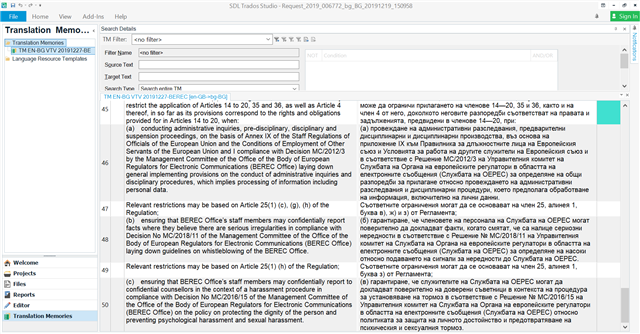
I create a new Main TM and then import a translation file into it. The file has 109 CONFIRMED units, but only 50 are imported intt the TM. These 50 are not sequential units - there are units missing in between. I tried to update the TM, but it still has only 50 units.

Parents
  • I guess you are only showing 50 at a time and you are on the first page.

    Paul Filkin | RWS

    Design your own training!
    You've done the courses and still need to go a little further, or still not clear? 
    Tell us what you need in our Community Solutions Hub

  • Hi Paul,

    Here is the page.

    I beg you to pardon my ignorance, but for 35 years working with a PC (10+ hours daily) I got used to scroll through pages by the mouse wheel, a scroll bar or in the worst case by clicking an arrow. Here I could not make use of any of these.

    Would you be so kind to advise me, please!

  • I’m replying from a phone so can’t get you a screenshot, but you are hiding the ribbon so you don’t see any of the navigation commands.

    Paul Filkin | RWS

    Design your own training!
    You've done the courses and still need to go a little further, or still not clear? 
    Tell us what you need in our Community Solutions Hub

  • Well Paul, forget it. I have already managed myself or rather noticed the page scrolling "button" in the ribbon. Brilliant idea to put it there! Very original! Did I mention I've been working with of-the-shelf and proprietary applications for 35 years, since Dos 3.1? Yes, I did. Now I must admit, after having struggled for 3 days with SDL Trados Studio 2017, that I've never seen such a "user-friendly" and "intuitive" application, as I already mentioned to your colleague Loredana.

    Well, I am a stubborn man and will go on enjoying the Studio for a while, but if it keeps surprising my in this pleasant way at each simple step, like e.g. creating/updating a TM or scrolling a page, I might decide that it is not worth wasting the time, especially when some free applications like Google Translator keep giving better and better translations at a simple click, with European Union documents reaching easily 95% precision in the EN-BG and BG-EN pair. And I can assure you Bulgarian is one of the toughest languages with most words having 20+ spelling variations depending on the gender, tense, singular or plural.

    I am not being nasty. I am just giving you free heads-up.

    Have nice winter holidays!

    Velizar

  • Former Member
    0 Former Member in reply to Velyo Tinkov

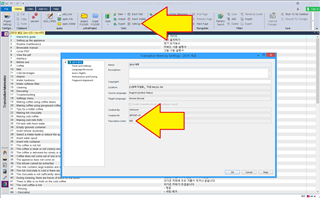
    Trados Studio screenshot showing an error message 'File type settings not found' with two yellow arrows pointing at the error and the file type settings window.

    emoji


    Generated Image Alt-Text
    [edited by: Trados AI at 7:39 PM (GMT 0) on 28 Feb 2024]
  • Thank you for your concern!

    I have already resolved the issue with the number of units per page and scrolling the pages of the TM.

  • Did I mention I've been working with of-the-shelf and proprietary applications for 35 years, since Dos 3.1?

    You and me both! But that doesn't give either of us the right to work without reading the manual first.

    with European Union documents reaching easily 95% precision in the EN-BG and BG-EN pair.

    In all european language pairs in fact... I wonder why that is?

    Paul Filkin | RWS

    Design your own training!
    You've done the courses and still need to go a little further, or still not clear? 
    Tell us what you need in our Community Solutions Hub

  • Back in 1993 I joined the first mobile operator in Bulgaria. The company has just been established (I was the 34-th member) and for the lack of real work I was given the task to study Excel from the manual (some 500 pages). Couple of hours later I threw it away and never opened it again. Still Excel became my main partner in my job and still is. Just by using it I managed to become quite proficient with it. This - first.

    Second. In Bulgaria we have this joke: "After exhausting all your genius ideas, read the manual." Being an engineer I usually read the manual first. I tried to do this with Trados too because I sensed it would not be easy to decipher it myself. First thing I did I downloaded the pdf Manual. Guess what - it goes up to page 38 (or so) and jumps directly to page 171 (or so). I tried finding the complete manual. You can guess the result. Obviously this is another peculiarity of Trados.

    In my engineering practice (including some programming in Assembler for Motorola 6800/68000 and Intel 8058/8086 processors when every byte of memory materred as the memories were usually in the range of 256/512 k per bulky chip) I have always put moron-proofness first, user friendliness second and everything else after them. What Trados lacks quite notably is user friendliness and intuitiveness. This, apart from making working with it difficult, also leads to many mistakes on the part of the user that some times may destroy all his work done so far. Looking for help I found that I am far from being alone in this opinion.

    I have lived long enough not to expect that any company will change its policy or even product for me, but this is me - I say what I believe I have to say.

    As to the European documents, they are very much of the same type, using the same cliche-phrases and terminology, great many people feed on chewing them constantly and last but not least, they are  very well structured both in style and grammar. One more thing - they are strongly bureaucratic. In the socialist times there was a slogan: "Proletarians from all the world, unite!" With the Berlin wall gone it was replaced by: "Bureaucrats from all the world, unite!". In translating these texts all bureaucrats consciously or not copy the style, structure and terminology of the source making the translation quite close to it. Al these result in the machine translation being practically perfect in both directions. With a simple contract for construction, illiterately compiled by some builder I manage to translate 2 pages of poor translation per hour and with an European document and Google on my side I easily make 8+ pages of perfect translation. Having in mind that a page in Bulgaria brings the translator just 3 euro, volume matters.

    And one more thing. Google moved to AI last year. At first this dropped the quality of their translation substantially, but this damn thing learns fast and becomes better every day. I am glad I would not have to make my living as translator 10-20 years from now.

    Sorry for the epistolary post!

  • Being an engineer I usually read the manual first. I tried to do this with Trados too because I sensed it would not be easy to decipher it myself. First thing I did I downloaded the pdf Manual. Guess what - it goes up to page 38 (or so) and jumps directly to page 171 (or so). I tried finding the complete manual. You can guess the result. Obviously this is another peculiarity of Trados.

    Either that or you were in fact looking at a trial copy of the manual from Mats Linder... this sounds more like it as we don't provide a PDF manual, only an online one.

    As to the European documents, they are very much of the same type, using the same cliche-phrases and terminology, great many people feed on chewing them constantly and last but not least, they are  very well structured both in style and grammar. One more thing - they are strongly bureaucratic. In the socialist times there was a slogan: "Proletarians from all the world, unite!" With the Berlin wall gone it was replaced by: "Bureaucrats from all the world, unite!". In translating these texts all bureaucrats consciously or not copy the style, structure and terminology of the source making the translation quite close to it. Al these result in the machine translation being practically perfect in both directions. With a simple contract for construction, illiterately compiled by some builder I manage to translate 2 pages of poor translation per hour and with an European document and Google on my side I easily make 8+ pages of perfect translation. Having in mind that a page in Bulgaria brings the translator just 3 euro, volume matters.

    I guess that's along way of sayng what I was getting at.  Google uses the bilingual corpora from the EU to help train it's engines, as do most MT providers.  So no surprises here at all.  Even prior to Neural MT these sorts of documents lent themselves pretty well to most providers.  But certainly today NMT has been a gamechanger.

    And one more thing. Google moved to AI last year. At first this dropped the quality of their translation substantially, but this damn thing learns fast and becomes better every day. I am glad I would not have to make my living as translator 10-20 years from now.

    You might find this an interesting read:

    https://csa-research.com/Insights/ArticleID/604/global-content-translation-volume

    Paul Filkin | RWS

    Design your own training!
    You've done the courses and still need to go a little further, or still not clear? 
    Tell us what you need in our Community Solutions Hub

Reply
  • Being an engineer I usually read the manual first. I tried to do this with Trados too because I sensed it would not be easy to decipher it myself. First thing I did I downloaded the pdf Manual. Guess what - it goes up to page 38 (or so) and jumps directly to page 171 (or so). I tried finding the complete manual. You can guess the result. Obviously this is another peculiarity of Trados.

    Either that or you were in fact looking at a trial copy of the manual from Mats Linder... this sounds more like it as we don't provide a PDF manual, only an online one.

    As to the European documents, they are very much of the same type, using the same cliche-phrases and terminology, great many people feed on chewing them constantly and last but not least, they are  very well structured both in style and grammar. One more thing - they are strongly bureaucratic. In the socialist times there was a slogan: "Proletarians from all the world, unite!" With the Berlin wall gone it was replaced by: "Bureaucrats from all the world, unite!". In translating these texts all bureaucrats consciously or not copy the style, structure and terminology of the source making the translation quite close to it. Al these result in the machine translation being practically perfect in both directions. With a simple contract for construction, illiterately compiled by some builder I manage to translate 2 pages of poor translation per hour and with an European document and Google on my side I easily make 8+ pages of perfect translation. Having in mind that a page in Bulgaria brings the translator just 3 euro, volume matters.

    I guess that's along way of sayng what I was getting at.  Google uses the bilingual corpora from the EU to help train it's engines, as do most MT providers.  So no surprises here at all.  Even prior to Neural MT these sorts of documents lent themselves pretty well to most providers.  But certainly today NMT has been a gamechanger.

    And one more thing. Google moved to AI last year. At first this dropped the quality of their translation substantially, but this damn thing learns fast and becomes better every day. I am glad I would not have to make my living as translator 10-20 years from now.

    You might find this an interesting read:

    https://csa-research.com/Insights/ArticleID/604/global-content-translation-volume

    Paul Filkin | RWS

    Design your own training!
    You've done the courses and still need to go a little further, or still not clear? 
    Tell us what you need in our Community Solutions Hub

Children
No Data