
How to achieve document-level or project-level context for MT and AI

I am looking for a way to achieve at least document-level context for MT and AI. The current solution is to run an AI platform in parallel and copy/paste from Trados Studio to the AI platform. There, and agent is equipped with the entire document (and reference material, if there is). I then manually paste the response back into Studio. So far, so good, but this is painfully manual and very slow.

I'd like to be able to tell Studio's AI assistant:

“Include the preceding X segments (or paragraphs) in your request. With (or without) translation.”

“Include the succeeding X segments (or paragraphs) in your request. (With or without translation, for the sake of completion, although this will usually be without unless I am in the role of the reviewer.)

I created an idea for this, please support:  Context-awareness for AI Assistent 

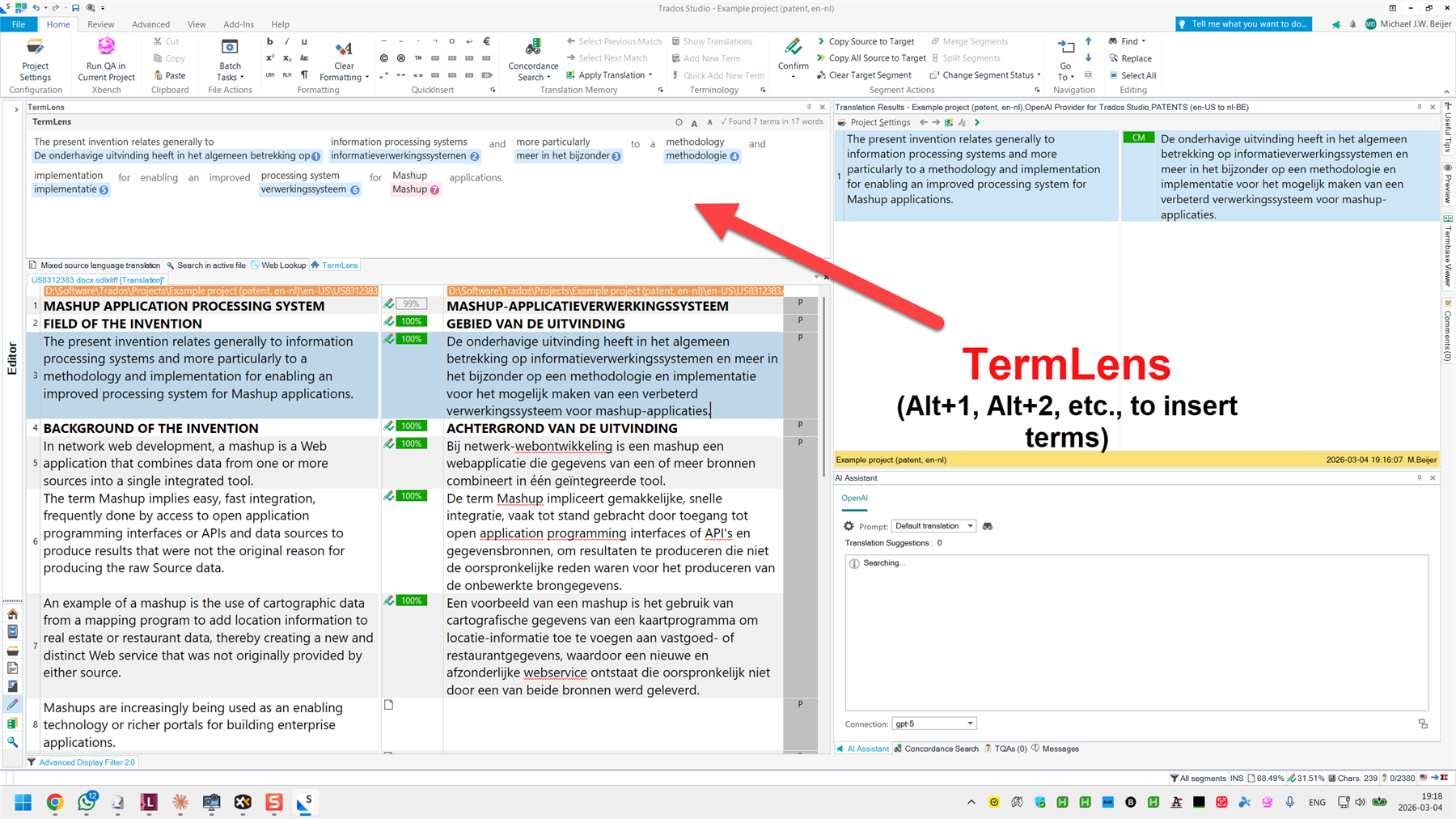
For terminology, very, very important: Include such-and-such a field in your request. This is how I can tell AI not to use TB entries with the status “deprecated” or “superseded”. There is an idea for this already, please support:  OpenAI Provider for Trados Studio: option to include term information in system prompt 

A lot happened recently with the AI Assistant (user can modify the system prompt)! Thank you for that!


Removed AI Suggestion
[edited by: Daniel Hug at 10:17 AM (GMT 0) on 13 Dec 2025]

emoji
Parents Reply
  •  

    I agree with you on many points.

    Document-level context vs. segment-level context:
    Once someone has tried using AI for translation with document-level context, they will never go back to segment translation. And the CAT industry must take this into account because the first solutions will reap the biggest rewards. However, this is not a trivial problem. Personally, I also would prefer to use Trados only for importing source files, as a QA tool, and for generating target documents. (https://posteditacat.xyz/beyond-segments-the-critical-role-of-context-in-modern-translation/).
    I think there are many translators who work this way or at least copy text from AI to their CAT tools, because they don't know that there are already tools for this purpose. I only now just found out about  Supervertaler for example.

    XLIFF process:
    My attempts to translate large XLIFF files with AI have not been very successful. XLIFF files are simply too large to be processed efficiently by AI. We could process them segment by segment, but then we wouldn't be able to retain the context of entire documents. Do you have any ideas for this?
    For projects with a lot of exact and fuzzy segments, I develop a compact JSON format containing only the necessary data (source, existing target, segment identification, and status), and it works surprisingly well when updating large projects.

    emoji
Children
No Data